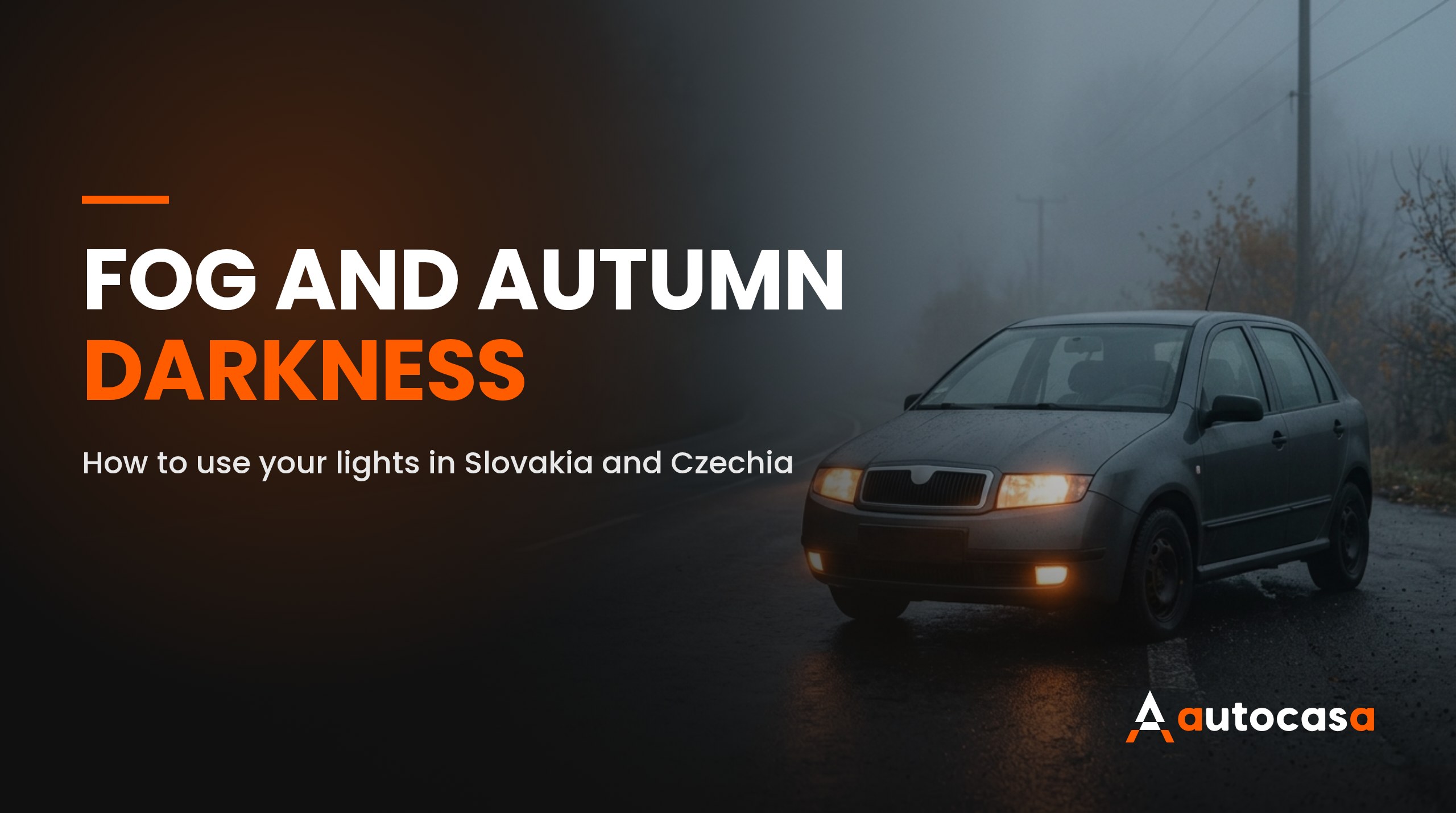
Foggy mornings, driving home in the dark, the first autumn rain. This is the time of year when you find out whether your car is actually visible to everyone else. If you drive in Slovakia or Czechia — for work, on a trip to buy a used car, or every day near the border — it pays to know the local lighting rules. They differ more than most drivers expect.
What Slovak law requires
Under Section 32 of Slovak Road Traffic Act No. 8/2009 Z. z., a vehicle must drive with dipped headlights or equivalent lighting, meaning daytime running lights, switched on. In normal visibility, daytime running lights are enough.
That changes the moment visibility is reduced. The law describes this as a situation in which road users cannot see each other clearly enough, or cannot see objects on the road — in particular from dusk until dawn, in fog, snowfall, rain and in tunnels. Daytime running lights are then no longer sufficient and you should switch to dipped beam.
In Czechia, Section 32 of Act No. 361/2000 Sb. applies. The rule is similar but worded more strictly: in reduced visibility the car must show position lights plus dipped (or main) beam, and daytime running lights alone are explicitly not enough.
Fog lights are not decoration
The most common autumn mistake is a rear fog light left on in ordinary rain. The Slovak rule leaves no room for interpretation: front fog lamps and the rear fog lamp may be used only in fog, snowfall or rain.
In Czechia the penalties have risen sharply. Improper use of fog lights can cost up to CZK 1,500 on the spot and CZK 2,000 to 5,000 in administrative proceedings. In Slovakia, an officer can issue an on-the-spot fine.
The reasoning is not bureaucratic. A rear fog lamp is almost as bright as a brake light: in good visibility it dazzles the driver behind you and hides the fact that you are braking. Practical test — switch fog lights on only once you struggle to make out the tail lights of the car ahead, and switch them off as soon as visibility improves.
The weak spot of daytime running lights
Daytime running lights shine forwards. At the back of most cars, nothing lights up at all. In rain, in the spray behind a truck or on a wooded bend, the car is perfectly visible from the front and almost invisible from behind. The automatic setting is not a reliable fix — the sensors react to brightness, not to water.
A simple rule: wipers on, lights on. Manually, not on auto.
A five-minute check before autumn
- Walk around the car with the lights on. Check dipped beam, position lights, brake lights, reversing light, indicators and the number plate lamp. Test the brake lights by wedging something against the pedal, or ask someone to help.
- Check the headlight aim. If oncoming drivers flash you, your beam is too high. Adjustment is cheap, and badly aimed headlights are among the defects found regularly at roadworthiness testing.
- Wash the headlights, not just the windscreen. A film of dust and salt cuts light output more than you would expect.
- Replace tired wiper blades. Rubber hardens after a season or two, and a smeared windscreen facing a low sun is as dangerous as a weak headlight.
- Top up winter screenwash and check that the heated rear window and the windscreen demister both work.
Cloudy headlights cost money when you sell
Polycarbonate headlight lenses yellow and go milky over the years. Beyond the noticeably weaker beam, this is the first thing a buyer spots at a viewing: the car looks older and less cared for than it really is.
A restoration kit costs a few tens of euros and takes a morning. If the lens is cracked or water is getting into the unit, look for a used original instead — far cheaper than a new part, especially with LED and matrix units.
Where to find a headlight, or sell yours
On AutoCasa, alongside cars, motorcycles, vans, trucks, buses and trailers, you will also find a spare parts category and, separately, wheels and tyres and bicycles. Listing is free, with no sales commission and no limit on the number of ads; promoting a listing is optional and starts at 1.50 €.
If you are selling a headlight from a damaged car, state the make, model, year, light type (halogen, xenon, LED), the side, and the part number moulded into the housing — and be upfront about cracks or broken mounting tabs. Photograph it from the front and the back, connectors included. It will save you dozens of messages asking the same thing.
And if you are choosing a used car in Slovakia or Czechia right now, ask the seller to switch every light on at once during the viewing. It takes five seconds and tells you more about the previous owner’s care than a thick service book.
This article is based on Slovak Act No. 8/2009 Z. z. on road traffic and Czech Act No. 361/2000 Sb., as in force in September 2026, and applies to Slovakia and Czechia. Rules in other countries may differ.
Leave a Reply