Electric car owners notice the first cold mornings before anyone else: the range figure on the display shrinks by tens of kilometres overnight. It is not a fault and it is not a reason to worry, it is physics. We looked at how much range winter really takes, what actually helps, and what anyone considering a used EV in Slovakia or the Czech Republic this season should check before paying.
Winter takes a fifth, hard frost up to a third
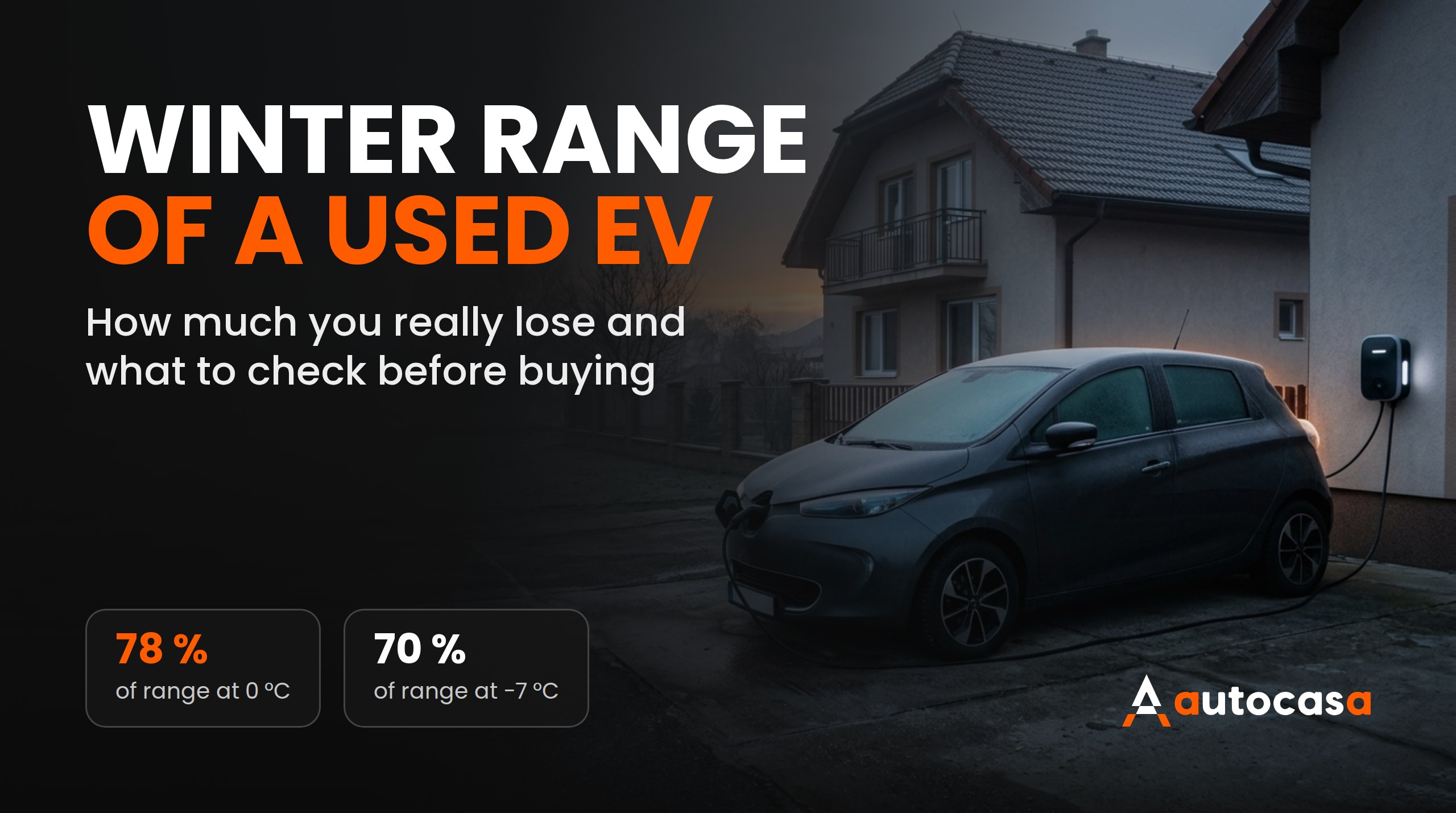
The largest available sample comes from the US platform Recurrent, which analysed telemetry from more than 30,000 electric cars across 34 models. At around 0 °C the vehicles held on to 78 per cent of their maximum range on average, and at roughly −7 °C only 70 per cent. The spread between models is wide: the best car in the comparison kept 88 per cent, the weakest 69 per cent.
The extreme came from the winter test run by the Norwegian automobile club NAF (El Prix 2026), which put 24 EVs through temperatures down to −32 °C in Folldal. The average shortfall against WLTP figures there was 38 per cent. Cold like that is rare in Central Europe, so a realistic expectation is that about 70 to 80 per cent of the stated range survives January.
In practice a car rated for 400 km will cover roughly 280 to 310 kilometres in freezing weather. If that covers your daily commute with something in reserve, winter will not be an issue.
Why consumption rises in the cold
Three things happen at once. The biggest is cabin heating. A combustion engine makes heat as a by-product and sends it into the cabin for free; an EV has to produce it from the battery, and that means several kilowatts. On a short trip to work, heating takes most of the energy the car uses.
The second is the chemistry of a cold battery: at low temperatures its internal resistance rises, so the same distance costs more energy. The third is limited regenerative braking. Until the battery reaches operating temperature, the car cannot recover full energy when braking and dissipates it in the mechanical brakes instead. Add the higher rolling resistance of winter tyres and driving through slush.
Heat pump and preconditioning: what genuinely helps
According to the same Recurrent data, a heat pump adds around 10 per cent of range at 0 °C, because it moves heat instead of generating it in a resistive element. Its efficiency drops in deep frost, but for Central European winters it is one of the most useful pieces of equipment a car can have. On many models it was a cost option, so of two otherwise identical used cars one may have it and the other may not.
The second habit that matters is preheating while the car is still plugged in. Cabin and battery are warmed with grid electricity rather than from the pack, and the car sets off ready. The same applies to charging: in the Norwegian test, most cars with a preconditioned battery came close to their stated 10 to 80 per cent charging time. Without preconditioning, rapid charging in the cold can take considerably longer, because the car itself reduces power to protect the cells.
Used EV: what to check before you buy
- Battery state of health (SoH): a study covering 22,700 vehicles found average degradation of about 2.3 per cent per year, leaving roughly 81.6 per cent of capacity after eight years. Below 80 per cent the missing range is noticeable, especially in winter.
- How the car was charged: cars charged mainly on alternating current (AC, so a wallbox or a domestic socket) aged at about 1.5 per cent per year in the same study, while those frequently rapid-charged (DC) averaged around 3.0 per cent.
- Heat pump: confirm the specification from the VIN or the service records, not from the wording of the advert.
- AC charging power: 11 kW three-phase versus 7.4 kW single-phase decides whether the car fills up overnight.
- Remaining battery warranty: most manufacturers guarantee 8 years or 160,000 km and at least 70 per cent capacity (Kia, for example, 7 years or 150,000 km). The warranty usually transfers to the next owner, so it carries real value.
- Service history and software: updates to battery and thermal management can change winter range. Ask for proof that the latest versions are installed.
What a battery test costs, Euro 7 and the vignettes
Battery condition can be measured independently of the seller. A quick test such as AVILOO Flash takes a few minutes on a stationary car and costs around 100 euros; the more thorough Premium test records the discharge curve from 100 down to 10 per cent during normal driving and comes to roughly 200 euros. Cheaper routes are a diagnostic check at an authorised workshop for 20 to 60 euros, or an OBD reader with an app for 50 to 100 euros. On a 15,000-euro car, a weaker result than expected is a clear argument on price.
New cars are helped by the European regulation Euro 7: the battery will have to retain at least 80 per cent of its original capacity after five years or 100,000 km, and 72 per cent after eight years or 160,000 km. This applies to new vehicle types from 29 November 2026 and to all newly sold cars from 29 November 2027. Used cars from earlier years are not covered, which is exactly why measuring SoH is worth the money.
Budget for road tolls in the country where you will actually drive. In Slovakia electric cars get no exemption: in 2026 the annual vignette costs the same as for a combustion car, 90 euros (30 days 17.10 euros, 10 days 10.80 euros). In the Czech Republic it is the other way round: electric and hydrogen vehicles use motorways free of charge, plug-in hybrids up to 50 g CO₂/km pay a quarter of the annual rate and CNG cars half. The new Czech governing coalition has, however, written into its programme the intention to scrap that advantage, at the earliest from 2027. For now it is only a plan that would require a change in the law.
Buying or selling an electric car?
Autumn is an interesting time on the Slovak and Czech used-EV market: some owners sell precisely because they would rather not deal with winter range, and prices are gentler than in spring. If you are looking, AutoCasa lists not only passenger cars but also motorcycles, vans and trucks, buses, trailers, spare parts, wheels and tyres, and bicycles.
If you are selling, listing on AutoCasa is free, with no sales commission and no limit on the number of adverts. Promoting a listing is optional and starts at 1.50 euros. With an electric car it pays to be specific: state the battery state of health, whether the car has a heat pump, the maximum AC and DC charging power, and the remaining battery warranty. Those are exactly the questions buyers ask, and an advert that answers them upfront attracts more serious offers.
Vignette prices apply to Slovakia and the Czech Republic under the tariffs in force for 2026; the battery durability requirements come from Regulation (EU) 2024/1257 (Euro 7). Winter range figures are taken from measurements by the Recurrent platform and from the winter test run by the Norwegian automobile club NAF (El Prix 2026). Correct as of September 2026.
Leave a Reply