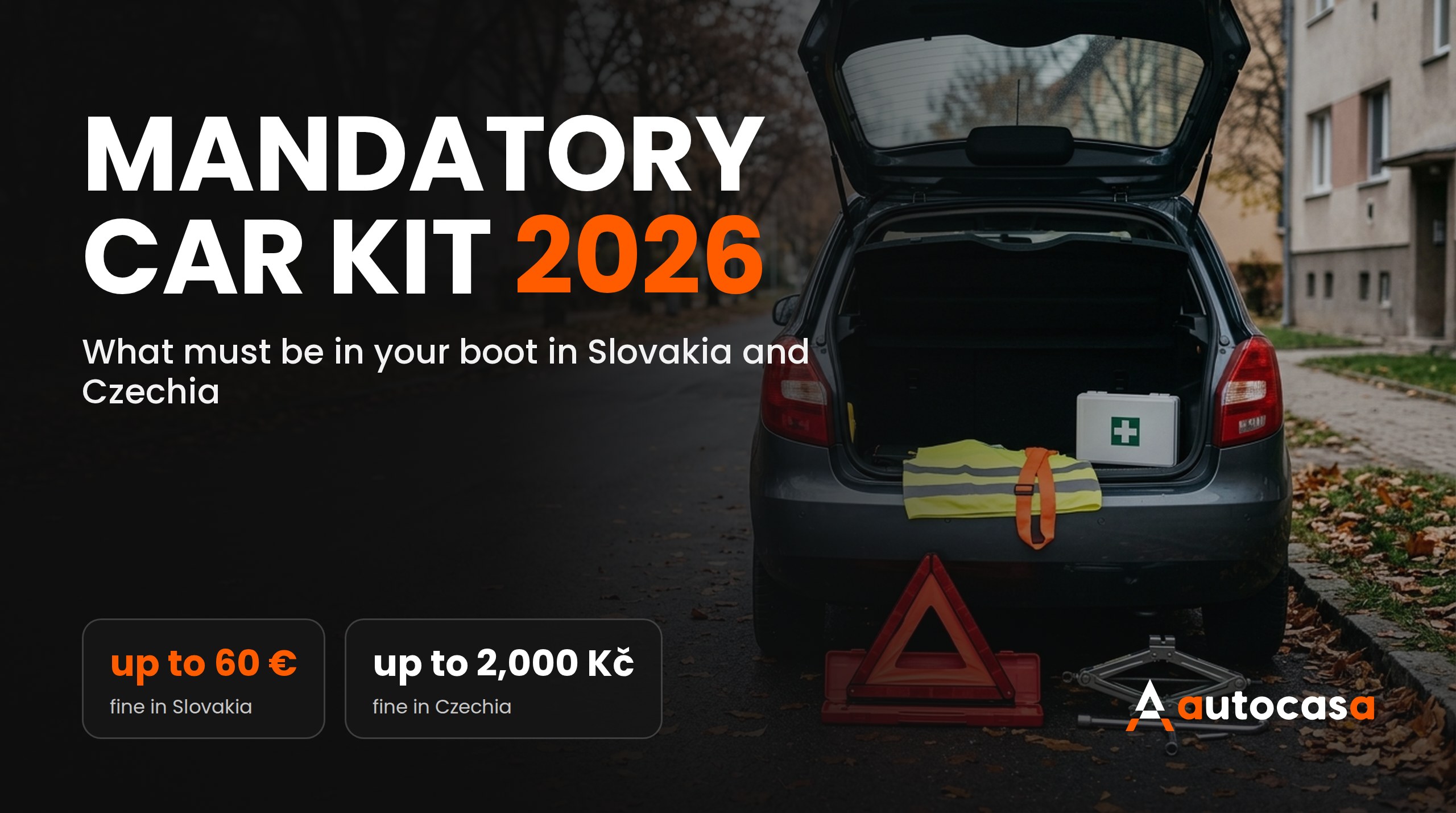
Most drivers only think about mandatory car equipment when they are standing on the hard shoulder or when a police officer opens the boot. Yet it comes down to a handful of items you can check in ten minutes. If you drive in Slovakia or Czechia – for work, on holiday or on your way to buy a used car – it pays to know what the local rules require. They differ from the rules you may be used to, and they differ from each other.
What a car must carry in Slovakia
Mandatory equipment is set out in Slovak Act No. 106/2018 Z. z. and Decree No. 134/2018 Z. z. For an ordinary passenger car up to 3.5 tonnes, that means four groups of items.
- A first-aid kit of the prescribed type – complete, unused and undamaged.
- A type-approved warning triangle, ideally in its protective case.
- A high-visibility vest meeting EN ISO 20471. One key detail: it must be within the driver’s reach, not in the boot under the spare wheel.
- A spare wheel with rim, a wheel wrench and a jack. Cars with run-flat tyres or a factory repair kit are exempt.
The Slovak kit is not a box of random bandages. The decree splits it into modules: protection and tools (gloves, scissors, emergency blanket, resuscitation mask), minor wounds, major wounds and bleeding, and fractures. A first-aid instruction card is part of the pack.
How the Czech rules differ
In Czechia, Decree No. 153/2023 Sb. applies. At first glance the list looks similar – first-aid kit, warning triangle, vest for the driver and a way to deal with a puncture – but the difference is in the detail.
The Czech rules explicitly allow three alternatives to a spare wheel: a tyre repair kit, run-flat tyres, or a valid roadside assistance service available around the clock. So if your car has no spare at all, one of those options is enough in Czechia. A jack and wheel wrench are only required if you actually carry a spare.
The kit contents differ too. The Czech version is simpler: three dressings with one pad, three with two pads, a roll of plaster, a rubber tourniquet, gloves, an emergency blanket and round-tipped scissors. A Slovak kit in a Czech car is not a problem – its contents go further.
First-aid kit: condition matters, not the date on the box
This is the point most drivers get wrong. In neither country is the printed expiry date the decisive criterion today. The rules require the contents to be complete, unused, clean and undamaged. At a roadside check or a technical inspection nobody reads the date on every bandage – what is checked is whether the kit is there at all and what state it is in.
That does not mean a ten-year-old kit is fine. A sterile dressing loses its sterility after years in a hot boot, the rubber tourniquet hardens and cracks, and the adhesive on the plaster dries out. A new kit costs around ten euros – one of the cheapest things you can refresh on a car.
What you no longer have to carry
The mandatory list has become shorter in both countries. You can take out of the boot:
- Spare bulbs and fuses. With modern LED and xenon headlights the driver would not replace them anyway.
- A tow rope for vehicles up to 3.5 tonnes.
- A fire extinguisher – not required in passenger cars.
- A paper accident statement form as a mandatory part of the equipment.
Be careful, though: “not mandatory” is not the same as “pointless”. A tow rope and a small box of fuses take up almost no space and will get you out of trouble one day. And after a minor collision, a statement filled in and signed by both parties is still the fastest route to a settled claim.
Fines and the most common mistakes
In Slovakia, missing or incomplete equipment carries a fine of up to 60 euros on the spot and up to 100 euros in administrative proceedings. In Czechia the same shortcoming can cost up to 2,000 Czech crowns. The amounts are not ruinous, but it is money thrown away for nothing.
Using the equipment incorrectly can cost more. The warning triangle belongs at least 50 metres behind the vehicle, and at least 100 metres on a motorway – not two metres behind the boot, where a driver in fog will see it too late. The vest goes on before you step out, which only works if it is in the cabin rather than under the luggage.
Buying used? Open the boot
When viewing a used car, everyone looks at the engine, the service book and the bodywork. Almost nobody opens the boot. Yet a minute there tells you several useful things: whether there is a spare wheel or only a repair kit, whether the jack and wheel wrench are missing, and whether a previous owner took something out after a puncture and never put it back.
A missing jack is no reason to walk away from a car, but it is a real budget item and a fair argument when negotiating the price. If you are the one selling, complete and clean equipment does more for a buyer’s confidence than three sentences about how well you looked after the car.
And if a tyre change or a car sale has left things in your garage you will never use again – rims, a set of tyres, a roof rack or spare parts – you can offer them to other drivers on AutoCasa. Listing is free, with no sales commission and no limit on the number of ads; promoting a listing is optional and starts at 1.50 €. Besides cars, there are categories for motorcycles, vans and trucks, buses, trailers, spare parts, rims and tyres, and bicycles.
This article describes the rules in force in Slovakia (Act No. 106/2018 Z. z., Decree No. 134/2018 Z. z.) and Czechia (Decree No. 153/2023 Sb.) as they stand in September 2026. These are not the rules of your own country – check the requirements of wherever you are travelling before you set off.
Leave a Reply