Author: AutoCasa Blog

  • Contract and re-registration: how to close a used-car sale safely in Slovakia

    Contract and re-registration: how to close a used-car sale safely in Slovakia

    Autumn is peak season on the Slovak and Czech used-car market. Hands are shaken, money changes owner and both sides drive off convinced the deal is done. In fact the most important part of the sale starts afterwards: on paper and at the registry office. Put it off and someone else is driving the car while your name is still on the record.

    The sales contract: two pages that protect you

    Slovak law prescribes neither a set form nor a notarised signature for a private car sale. That does not make the contract optional. It is the only evidence of when and for how much the vehicle changed hands, what condition it was in and what the parties agreed. In a dispute over a hidden defect, or when a fine arrives a week after the sale, the contract is what you rely on.

    The contract should contain:

    • Details of both parties: name, address, date of birth or company number, copied from an ID document rather than taken by dictation.
    • Precise identification of the vehicle: make, model, VIN, registration number, colour and the number of the registration certificate. Check the VIN on the car itself, not only in the papers.
    • The odometer reading on the day of sale, in figures and in words.
    • The price and method of payment (cash, transfer), plus a receipt for the money handed over.
    • Date and time of handover – from that moment the buyer is responsible for the car.
    • A statement of condition: a list of known faults and damage. It protects the seller against claims about what the buyer saw and accepted.

    Print the contract twice and have both copies signed. A certified signature is needed only on a power of attorney, not on the contract itself.

    Re-registration in Slovakia: one visit, 30 days

    Since January 2023 the transfer in Slovakia is handled in a single step at any traffic inspectorate. The change of keeper is reported by the person acquiring ownership, within 30 days of the sale.

    Both parties can attend together, or just one – in which case a written power of attorney with an officially certified signature (notary or registry office) is required. Transfers between close relatives in direct line are exempt.

    Bring an ID document, registration certificate parts I and II, the contract, the power of attorney if one side is missing, and proof of the new keeper’s third-party liability insurance. This is where most appointments fail: the previous policy ends the moment the change of keeper is recorded, so the buyer must arrange cover beforehand.

    What it costs in Slovakia

    The registration fee for a new keeper is not a flat rate. A rate based on engine power is multiplied by an environmental coefficient tied to the emission standard. The rate starts at 33 € for engines up to 80 kW and rises with power. The coefficient pulls the figure back down: Euro 6d is 0.40, plug-in hybrids and hydrogen 0.20, vehicles over 40 years old just 0.10. The oldest cars in the Euro 1 standard have 1.00 and pay the full rate. Electric cars pay a flat 33 € regardless of power.

    A typical used car with 90 kW and Euro 6d therefore costs 60 € × 0.40, that is 24 €. Filing the application electronically via the slovensko.sk portal (a Slovak eID and qualified signature are required) earns a 50 % discount, capped at 50 €. Since 2023 the plates belong to the vehicle: they are not changed on sale and cost nothing.

    Buying in Czechia? Different rules apply

    Used cars cross the border daily and Czech rules are stricter on several points. The buyer must file the application to register the new owner within 10 working days of the transfer of title, and missing the deadline can cost up to CZK 50,000 (roughly 2,000 €). The administrative fee for a passenger car is CZK 800 (roughly 33 €), or CZK 640 through the Portál dopravy.

    Czechia also charges a one-off environmental fee on older vehicles: CZK 3,000 for Euro 2, CZK 5,000 for Euro 1 and CZK 10,000 for vehicles with no standard at all. Euro 3 and newer are exempt. On a cheap fifteen-year-old car that fee can wipe out the saving on the price.

    What happens if you delay

    As long as your name is on the record, the authorities treat you as the responsible party: keeper-liability fines for speeding and parking, checks on valid insurance and, in Czechia, on the motorway vignette. Explaining six months later that the car was sold is possible – but only with the contract you kept.

    Hence a simple rule: money, keys and transfer on the same day. If that is not possible, agree the appointment at the moment of signing and write it into the contract.

    Where the sale begins

    The paperwork takes an afternoon, but first you need a buyer. On AutoCasa listings are free, with no sales commission and no limit on how many you post – cars and vans, motorcycles, trucks, buses, trailers, spare parts, wheels and tyres, and bicycles. Promoting a listing is optional and starts at 1.50 €.

    You will sell faster if the listing already answers what the buyer would ask anyway: true mileage, validity of the roadworthiness test, service history, number of owners and known faults. Take a printed contract to every viewing – if someone decides on the spot, you will not be hunting for a printer.

    The rules described apply to Slovakia (Acts No. 8/2009 Z. z. and No. 145/1995 Z. z.) and to Czechia (Act No. 56/2001 Sb.), as in force in September 2026. They are not the rules of your own country. Check the fee amount in the official calculator before your visit.
  • Roadworthiness test in Slovakia: deadlines, costs and why cars fail

    Roadworthiness test in Slovakia: deadlines, costs and why cars fail

    Most people think about the roadworthiness test only once the deadline has already passed. If you drive a Slovak-registered car or plan to buy a used one in Slovakia or Czechia, it pays to know the local rules: the deadlines, the cost, and the reasons why almost one in eight Slovak vehicles failed at the first attempt in 2024.

    The deadlines in Slovakia

    For M1 passenger cars, Slovakia applies a simple 4 – 2 – 2 rule: the first technical inspection (STK) no later than four years after first registration, then every two years. The emissions test (EK) follows the same schedule for diesel engines and for petrol engines with a catalytic converter and lambda sensor.

    Older petrol cars without a regulated catalytic converter are the exception: emissions testing after one year, then annually. Shorter intervals also apply to taxis and driving-school vehicles. Neighbouring Czechia works almost identically – first inspection after four years, then every two years.

    Watch the sticker on the licence plate: it shows only the month and year. The exact last day of validity is in the inspection report. You can also check validity free of charge online with the authorised technical service (testek.sk).

    What it costs

    Prices in Slovakia are not regulated – every station sets its own. As a guide, expect around 40 € for the technical inspection and roughly 35 € for the emissions test, so usually 65 to 95 € in total depending on the region and the station. For LPG cars the emissions test is a little more expensive, around 45 €.

    If the car fails, a re-test at the same station within 60 days is considerably cheaper, because only the recorded defects are checked. That is exactly why it makes sense to go early rather than in the final week before the deadline.

    Why cars fail

    In 2024 roughly 1.58 million technical inspections were carried out in Slovakia and 88.33 % of vehicles were found roadworthy. The list of the most common reasons for failure barely changes from year to year:

    • Brakes – uneven service-brake action, fluctuating braking force, a weak parking brake, worn discs. The number one cause for years.
    • Lighting – a dead brake light or indicator, badly aimed headlights, a burnt-out number plate light.
    • Corrosion of load-bearing parts – sills, wheel arches and axle mountings on cars with many winters behind them.
    • Tyres – insufficient tread depth, different types on one axle, or a size that does not match the documents.
    • Fluid leaks – brake fluid and engine oil above all.

    What to check the day before

    Most of the small stuff shows up in a car park. Ask someone to help and check every light, including reverse, fog lights and the plate light. Top up the washer fluid, replace wiper blades that smear, inflate the tyres to the specified pressure and measure the tread.

    Bring the registration certificate, proof of third-party liability insurance and the mandatory equipment. An illuminated airbag, ABS or engine warning light usually counts as a serious defect, so deal with it beforehand. And if you mostly drive short urban trips, take a longer run before the emissions test so the engine and catalytic converter reach working temperature.

    What happens if you miss the deadline

    A driver caught in Slovakia without a valid inspection faces an on-the-spot fine of up to 50 €, or up to 100 € in administrative proceedings. The penalty aimed at the vehicle keeper is considerably harsher: the district authority imposes 165 € for failing to present the vehicle for technical inspection and the same again for the emissions test – up to 330 € in total, per vehicle.

    Add to that the risk in the event of a claim. An expired inspection alone does not void your cover, but if the insurer shows that poor technical condition contributed to the damage, it can reduce the payout or demand it back.

    Why it matters when buying and selling

    A vehicle needs a valid technical inspection and emissions test to be transferred to a new owner, so the inspection date directly affects how quickly a deal can close. If you are selling, a fresh inspection is one of the cheapest ways to make a listing credible: put the expiry date in the text and add a photo of the report.

    If you are buying, always ask for the report. Besides the list of defects it records the odometer reading at the time of the inspection, so older reports are a simple way to sanity-check mileage. A car whose inspection expires in a few weeks is not a bad buy, but it should be reflected in the price.

    When it is your turn to sell, listing on AutoCasa is free, with no sales commission and no limit on the number of ads – from cars and motorcycles through vans, trucks and buses to trailers, spare parts, wheels and tyres or bicycles. Promoting a listing is optional and starts at 1.50 €.

    This article describes the rules in force in Slovakia – Act No. 106/2018 Coll. on the operation of vehicles and Act No. 8/2009 Coll. on road traffic, as in force in September 2026. Other countries have their own rules. Inspection prices are not regulated and differ between stations.

  • Used EV before winter: how much range you lose and what to check before buying

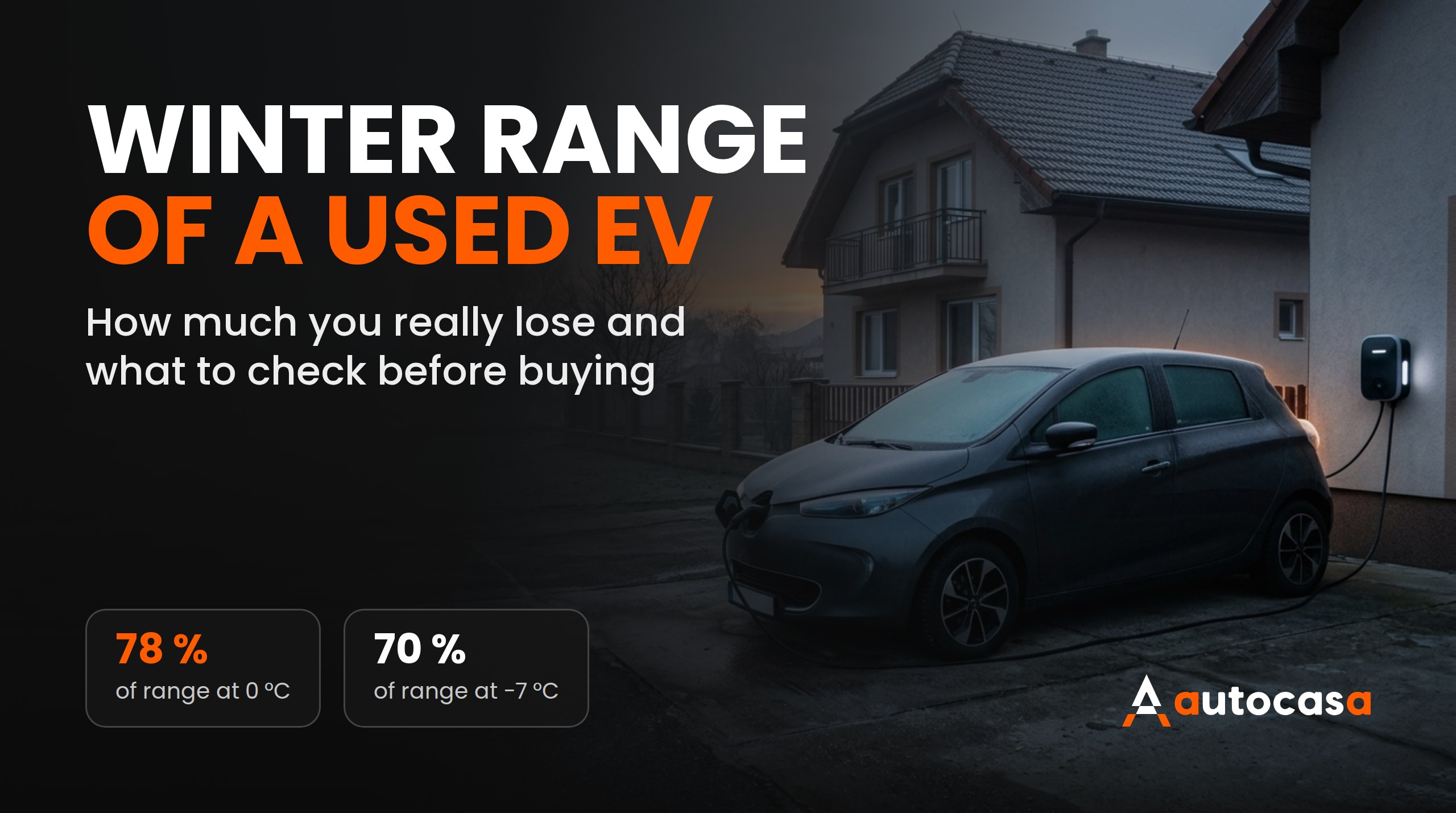
    Used EV before winter: how much range you lose and what to check before buying

    Electric car owners notice the first cold mornings before anyone else: the range figure on the display shrinks by tens of kilometres overnight. It is not a fault and it is not a reason to worry, it is physics. We looked at how much range winter really takes, what actually helps, and what anyone considering a used EV in Slovakia or the Czech Republic this season should check before paying.

    Winter takes a fifth, hard frost up to a third

    The largest available sample comes from the US platform Recurrent, which analysed telemetry from more than 30,000 electric cars across 34 models. At around 0 °C the vehicles held on to 78 per cent of their maximum range on average, and at roughly −7 °C only 70 per cent. The spread between models is wide: the best car in the comparison kept 88 per cent, the weakest 69 per cent.

    The extreme came from the winter test run by the Norwegian automobile club NAF (El Prix 2026), which put 24 EVs through temperatures down to −32 °C in Folldal. The average shortfall against WLTP figures there was 38 per cent. Cold like that is rare in Central Europe, so a realistic expectation is that about 70 to 80 per cent of the stated range survives January.

    In practice a car rated for 400 km will cover roughly 280 to 310 kilometres in freezing weather. If that covers your daily commute with something in reserve, winter will not be an issue.

    Why consumption rises in the cold

    Three things happen at once. The biggest is cabin heating. A combustion engine makes heat as a by-product and sends it into the cabin for free; an EV has to produce it from the battery, and that means several kilowatts. On a short trip to work, heating takes most of the energy the car uses.

    The second is the chemistry of a cold battery: at low temperatures its internal resistance rises, so the same distance costs more energy. The third is limited regenerative braking. Until the battery reaches operating temperature, the car cannot recover full energy when braking and dissipates it in the mechanical brakes instead. Add the higher rolling resistance of winter tyres and driving through slush.

    Heat pump and preconditioning: what genuinely helps

    According to the same Recurrent data, a heat pump adds around 10 per cent of range at 0 °C, because it moves heat instead of generating it in a resistive element. Its efficiency drops in deep frost, but for Central European winters it is one of the most useful pieces of equipment a car can have. On many models it was a cost option, so of two otherwise identical used cars one may have it and the other may not.

    The second habit that matters is preheating while the car is still plugged in. Cabin and battery are warmed with grid electricity rather than from the pack, and the car sets off ready. The same applies to charging: in the Norwegian test, most cars with a preconditioned battery came close to their stated 10 to 80 per cent charging time. Without preconditioning, rapid charging in the cold can take considerably longer, because the car itself reduces power to protect the cells.

    Used EV: what to check before you buy

    • Battery state of health (SoH): a study covering 22,700 vehicles found average degradation of about 2.3 per cent per year, leaving roughly 81.6 per cent of capacity after eight years. Below 80 per cent the missing range is noticeable, especially in winter.
    • How the car was charged: cars charged mainly on alternating current (AC, so a wallbox or a domestic socket) aged at about 1.5 per cent per year in the same study, while those frequently rapid-charged (DC) averaged around 3.0 per cent.
    • Heat pump: confirm the specification from the VIN or the service records, not from the wording of the advert.
    • AC charging power: 11 kW three-phase versus 7.4 kW single-phase decides whether the car fills up overnight.
    • Remaining battery warranty: most manufacturers guarantee 8 years or 160,000 km and at least 70 per cent capacity (Kia, for example, 7 years or 150,000 km). The warranty usually transfers to the next owner, so it carries real value.
    • Service history and software: updates to battery and thermal management can change winter range. Ask for proof that the latest versions are installed.

    What a battery test costs, Euro 7 and the vignettes

    Battery condition can be measured independently of the seller. A quick test such as AVILOO Flash takes a few minutes on a stationary car and costs around 100 euros; the more thorough Premium test records the discharge curve from 100 down to 10 per cent during normal driving and comes to roughly 200 euros. Cheaper routes are a diagnostic check at an authorised workshop for 20 to 60 euros, or an OBD reader with an app for 50 to 100 euros. On a 15,000-euro car, a weaker result than expected is a clear argument on price.

    New cars are helped by the European regulation Euro 7: the battery will have to retain at least 80 per cent of its original capacity after five years or 100,000 km, and 72 per cent after eight years or 160,000 km. This applies to new vehicle types from 29 November 2026 and to all newly sold cars from 29 November 2027. Used cars from earlier years are not covered, which is exactly why measuring SoH is worth the money.

    Budget for road tolls in the country where you will actually drive. In Slovakia electric cars get no exemption: in 2026 the annual vignette costs the same as for a combustion car, 90 euros (30 days 17.10 euros, 10 days 10.80 euros). In the Czech Republic it is the other way round: electric and hydrogen vehicles use motorways free of charge, plug-in hybrids up to 50 g CO₂/km pay a quarter of the annual rate and CNG cars half. The new Czech governing coalition has, however, written into its programme the intention to scrap that advantage, at the earliest from 2027. For now it is only a plan that would require a change in the law.

    Buying or selling an electric car?

    Autumn is an interesting time on the Slovak and Czech used-EV market: some owners sell precisely because they would rather not deal with winter range, and prices are gentler than in spring. If you are looking, AutoCasa lists not only passenger cars but also motorcycles, vans and trucks, buses, trailers, spare parts, wheels and tyres, and bicycles.

    If you are selling, listing on AutoCasa is free, with no sales commission and no limit on the number of adverts. Promoting a listing is optional and starts at 1.50 euros. With an electric car it pays to be specific: state the battery state of health, whether the car has a heat pump, the maximum AC and DC charging power, and the remaining battery warranty. Those are exactly the questions buyers ask, and an advert that answers them upfront attracts more serious offers.

    Vignette prices apply to Slovakia and the Czech Republic under the tariffs in force for 2026; the battery durability requirements come from Regulation (EU) 2024/1257 (Euro 7). Winter range figures are taken from measurements by the Recurrent platform and from the winter test run by the Norwegian automobile club NAF (El Prix 2026). Correct as of September 2026.

  • Mandatory car equipment 2026: what must be in your boot in Slovakia and Czechia

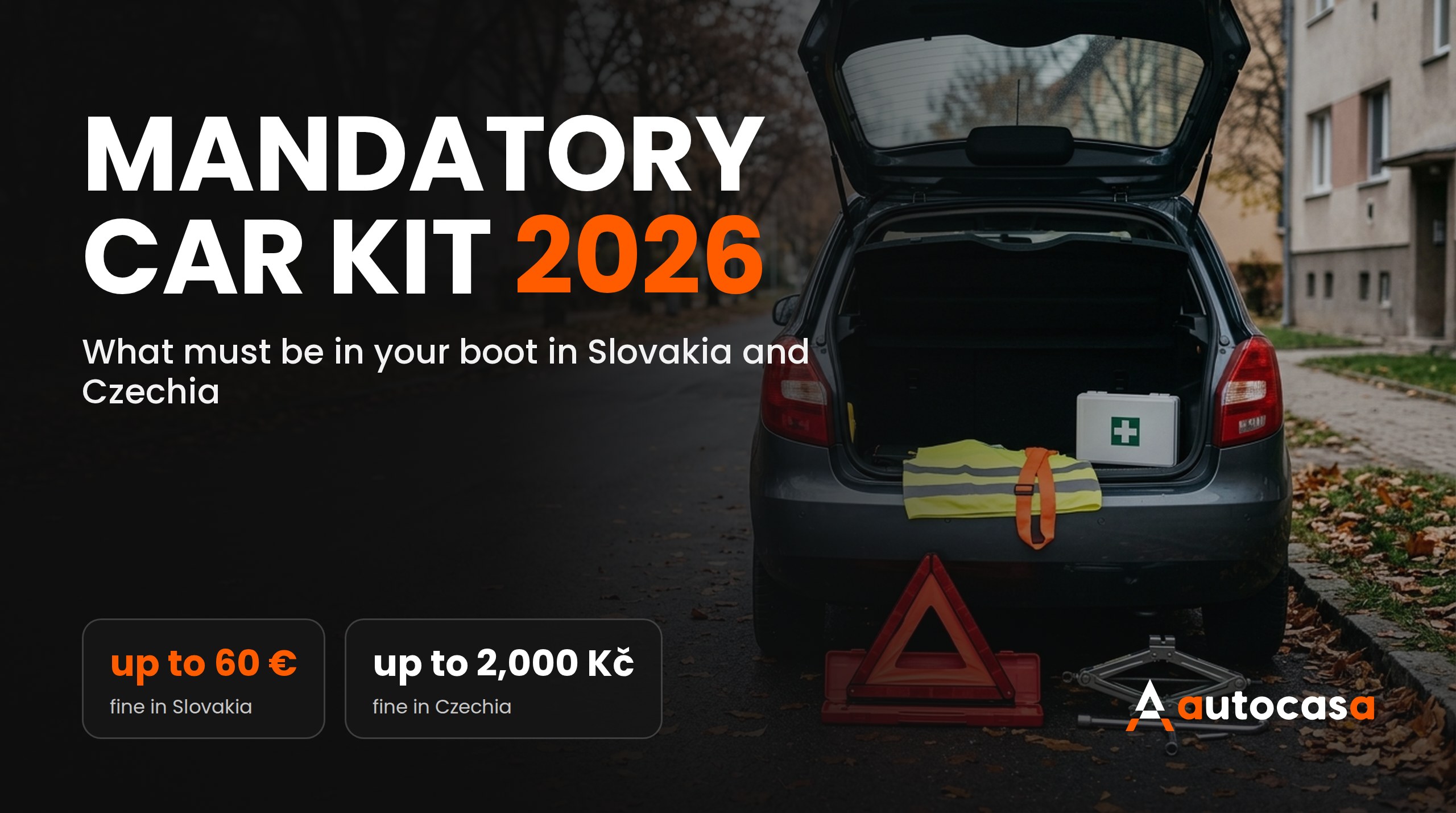
    Mandatory car equipment 2026: what must be in your boot in Slovakia and Czechia

    Most drivers only think about mandatory car equipment when they are standing on the hard shoulder or when a police officer opens the boot. Yet it comes down to a handful of items you can check in ten minutes. If you drive in Slovakia or Czechia – for work, on holiday or on your way to buy a used car – it pays to know what the local rules require. They differ from the rules you may be used to, and they differ from each other.

    What a car must carry in Slovakia

    Mandatory equipment is set out in Slovak Act No. 106/2018 Z. z. and Decree No. 134/2018 Z. z. For an ordinary passenger car up to 3.5 tonnes, that means four groups of items.

    • A first-aid kit of the prescribed type – complete, unused and undamaged.
    • A type-approved warning triangle, ideally in its protective case.
    • A high-visibility vest meeting EN ISO 20471. One key detail: it must be within the driver’s reach, not in the boot under the spare wheel.
    • A spare wheel with rim, a wheel wrench and a jack. Cars with run-flat tyres or a factory repair kit are exempt.

    The Slovak kit is not a box of random bandages. The decree splits it into modules: protection and tools (gloves, scissors, emergency blanket, resuscitation mask), minor wounds, major wounds and bleeding, and fractures. A first-aid instruction card is part of the pack.

    How the Czech rules differ

    In Czechia, Decree No. 153/2023 Sb. applies. At first glance the list looks similar – first-aid kit, warning triangle, vest for the driver and a way to deal with a puncture – but the difference is in the detail.

    The Czech rules explicitly allow three alternatives to a spare wheel: a tyre repair kit, run-flat tyres, or a valid roadside assistance service available around the clock. So if your car has no spare at all, one of those options is enough in Czechia. A jack and wheel wrench are only required if you actually carry a spare.

    The kit contents differ too. The Czech version is simpler: three dressings with one pad, three with two pads, a roll of plaster, a rubber tourniquet, gloves, an emergency blanket and round-tipped scissors. A Slovak kit in a Czech car is not a problem – its contents go further.

    First-aid kit: condition matters, not the date on the box

    This is the point most drivers get wrong. In neither country is the printed expiry date the decisive criterion today. The rules require the contents to be complete, unused, clean and undamaged. At a roadside check or a technical inspection nobody reads the date on every bandage – what is checked is whether the kit is there at all and what state it is in.

    That does not mean a ten-year-old kit is fine. A sterile dressing loses its sterility after years in a hot boot, the rubber tourniquet hardens and cracks, and the adhesive on the plaster dries out. A new kit costs around ten euros – one of the cheapest things you can refresh on a car.

    What you no longer have to carry

    The mandatory list has become shorter in both countries. You can take out of the boot:

    • Spare bulbs and fuses. With modern LED and xenon headlights the driver would not replace them anyway.
    • A tow rope for vehicles up to 3.5 tonnes.
    • A fire extinguisher – not required in passenger cars.
    • A paper accident statement form as a mandatory part of the equipment.

    Be careful, though: “not mandatory” is not the same as “pointless”. A tow rope and a small box of fuses take up almost no space and will get you out of trouble one day. And after a minor collision, a statement filled in and signed by both parties is still the fastest route to a settled claim.

    Fines and the most common mistakes

    In Slovakia, missing or incomplete equipment carries a fine of up to 60 euros on the spot and up to 100 euros in administrative proceedings. In Czechia the same shortcoming can cost up to 2,000 Czech crowns. The amounts are not ruinous, but it is money thrown away for nothing.

    Using the equipment incorrectly can cost more. The warning triangle belongs at least 50 metres behind the vehicle, and at least 100 metres on a motorway – not two metres behind the boot, where a driver in fog will see it too late. The vest goes on before you step out, which only works if it is in the cabin rather than under the luggage.

    Buying used? Open the boot

    When viewing a used car, everyone looks at the engine, the service book and the bodywork. Almost nobody opens the boot. Yet a minute there tells you several useful things: whether there is a spare wheel or only a repair kit, whether the jack and wheel wrench are missing, and whether a previous owner took something out after a puncture and never put it back.

    A missing jack is no reason to walk away from a car, but it is a real budget item and a fair argument when negotiating the price. If you are the one selling, complete and clean equipment does more for a buyer’s confidence than three sentences about how well you looked after the car.

    And if a tyre change or a car sale has left things in your garage you will never use again – rims, a set of tyres, a roof rack or spare parts – you can offer them to other drivers on AutoCasa. Listing is free, with no sales commission and no limit on the number of ads; promoting a listing is optional and starts at 1.50 €. Besides cars, there are categories for motorcycles, vans and trucks, buses, trailers, spare parts, rims and tyres, and bicycles.

    This article describes the rules in force in Slovakia (Act No. 106/2018 Z. z., Decree No. 134/2018 Z. z.) and Czechia (Decree No. 153/2023 Sb.) as they stand in September 2026. These are not the rules of your own country – check the requirements of wherever you are travelling before you set off.

  • Uninsured car in Slovakia: automatic fines from 1 October 2026

    Uninsured car in Slovakia: automatic fines from 1 October 2026

    If you own, buy or sell a car registered in Slovakia, put 1 October 2026 in your calendar. From that date the state checks motor third-party liability insurance automatically, straight from its databases. An uninsured vehicle fails both the technical and the emissions test, and the fine arrives in the post. Here are the exact amounts and deadlines.

    What changed in Slovakia

    The amendment known locally as Lex PZP – Act No. 77/2026 Coll., which amends Act No. 381/2001 Coll. on compulsory motor third-party liability insurance – took effect on 1 August 2026. The first weeks were mostly about warnings: the vehicle register was linked to the register of the Slovak Insurers’ Bureau and keepers of uninsured cars received notices.

    Since 1 October 2026 the system runs at full strength. If a registered vehicle has no valid policy for more than 30 days, the district authority can impose a fine in an order procedure – purely on the basis of register data, without a classic administrative hearing. Liability is strict: nobody asks whether the car was actually driven.

    What an uninsured vehicle costs

    The amount does not depend on how long the car was uninsured, but on its maximum permissible weight:

    • €120 – vehicles up to 750 kg, for example trailers
    • €300 – over 750 kg up to 3,500 kg, meaning ordinary cars, vans and motorcycles
    • €600 – over 3,500 kg up to 12,000 kg
    • €900 – over 12,000 kg
    • double the amount for a repeat offence; a further fine can only follow at least 150 days after the previous decision became final

    How to cut the fine to a third

    Lawmakers assumed that most uninsured vehicles are down to forgetfulness rather than bad faith. Two reductions are therefore available, both tied to a 15-day deadline from delivery of the order:

    • Paying within 15 days cuts the fine by a third – for a passenger car from €300 to €200.
    • If within the same period you also prove that the vehicle has been insured or deregistered, it drops by another third, to €100.

    Leaving the envelope from the authority in a drawer is, in this case, the most expensive option available.

    No insurance, no roadworthiness test

    The second change affects properly insured owners too. Since October, testing stations verify the policy directly in the database. If the vehicle is not listed as insured, neither the technical nor the emissions test can end with a pass, no matter what condition the car is in.

    Checking is free: the Slovak Insurers’ Bureau runs a public search for a vehicle’s insurer by registration number or VIN on its website. That is worth doing especially if the policy was taken out only hours before the appointment, or if you have just switched insurers.

    A car that never moves: temporary deregistration

    The classic case: the car has been sitting in a garage for two years, nobody drives it, the policy expired long ago. Under the new rules, that is exactly the vehicle the payment order will find.

    The answer is temporary deregistration, available at any traffic inspectorate or online through the slovensko.sk portal. The fee starts at €5 for up to one year (half that for an electronic application) and rises with the length of the period. During that time no insurance is needed and the insurer refunds the unused premium. Vehicles left uninsured for a very long time, on the other hand, can be struck off the register permanently by the authorities.

    When buying or selling, the transfer date decides

    The most common misconception: the seller assumes the policy carries on for the buyer. It does not. Slovak compulsory insurance ends the moment the change of keeper is entered in the register. The seller is entitled to a refund of the remaining premium, and the buyer needs their own contract on the day of the transfer – not “sometime this week”.

    • Buying? Arrange insurance before you drive home. The VIN and the details from the registration certificate are enough; an online policy takes a few minutes.
    • Selling? After the transfer, notify your insurer that the contract has ended and ask for the refund.
    • Buying a car that stood for years? Check whether it is temporarily deregistered and how long its roadworthiness test is still valid.

    Better to sell a car you no longer use

    If there is a car in your yard you no longer need, the new rules are a good reason to settle the matter: either deregister it temporarily, or find it a new owner while it still has value.

    On AutoCasa, listing is free, with no sales commission and no limit on the number of adverts. You can list cars, motorcycles, vans and trucks, buses, trailers, spare parts, wheels and tyres, and bicycles. Promoting a listing is optional and starts at €1.50.

    For a car that has been standing a long time, say openly in the advert since when it has not been driven and whether it is still registered. You will save yourself repeated questions and reach the buyers who are looking for exactly that kind of car.

    This article describes the rules in force in Slovakia: Act No. 381/2001 Coll. as amended by Act No. 77/2026 Coll. (Lex PZP), as of September 2026. Other countries have their own rules.

  • Check a used car before you pay: liens, mileage and paperwork

    Check a used car before you pay: liens, mileage and paperwork

    Autumn is the busiest stretch of the year on the Slovak and Czech used-car market before winter sets in. Decisions get made fast, and that is exactly when buyers miss what listing photos never show: a lien registered by a bank, a mileage figure that does not match the paperwork, or a seller who is not the registered keeper at all. The good news is that most of it can be checked in a few minutes and for a few euros, before any deposit changes hands.

    Liens: the most expensive mistake, avoided in five minutes

    A failing gearbox is annoying but repairable. The far worse scenario is a car that still carries a lien from the previous owner’s loan or lease. The buyer registers the car properly, drives it for months – and then the creditor who financed the loan comes forward.

    In Slovakia the central lien register (Notársky centrálny register záložných práv) is maintained by the Slovak Chamber of Notaries and is available at notar.sk. You can search by the debtor’s name or company number, by the description of the pledged item, and since 2023 also directly by the vehicle’s VIN. It is the first thing to do the moment a seller sends you the VIN – before you drive anywhere to view the car.

    If a seller refuses to share the VIN because “you don’t give that out”, you already have your answer. A VIN is not sensitive data, it cannot be used against the owner, and a serious seller puts it straight into the listing.

    Mileage: the register the seller cannot touch

    An odometer reading can be rewritten; the history of recorded readings cannot. In Slovakia that history sits in the Register prevádzkových záznamov vozidiel (rpzv.sk), fed by roadworthiness and emissions tests, originality checks, garages, insurers and other parties that come into contact with the vehicle.

    Two kinds of report can be ordered. ODO-PASS shows the odometer history and costs from 0.24 € for a single record up to 7.90 € for a report with several entries. AUTO-PASS goes further: alongside mileage it covers leasing, liens, vehicle blocks and the record of technical and emissions inspections. It comes in three versions priced from 5.90 € to 16.90 €. The register now also offers a separate report on recorded damage.

    The practical effect is simple. If the seller says the car has done 140,000 km but an inspection two years ago recorded 190,000, there is nothing left to discuss. A report costing a few euros, on a car costing several thousand, is the cheapest insurance you can buy.

    Documents, the VIN on the body, and stolen vehicles

    At the viewing, ask for the registration certificate and compare it with the car: the VIN on the manufacturer’s plate and on the body must match the VIN in the document, as must the year of manufacture and the basic technical data. If anything fails to line up, the viewing is over – no matter how good the car looks.

    Whether a vehicle is wanted can be checked in the stolen vehicle database run by the Slovak Ministry of the Interior. Also confirm that the seller is genuinely the keeper named on the registration certificate. If not, ask for a written power of attorney – selling “for a friend” without paperwork is an unnecessary risk when it comes to the transfer.

    Buying in Czechia: different registers, and some of them free

    The Czech Ministry of Transport has opened up vehicle register data to the public at dataovozidlech.cz. On kontrolatachometru.cz, the odometer readings taken at technical inspections have been joined by data from the inspection reports themselves, including the defects found. The Czech police run a public search for wanted vehicles, and the Czech Insurers’ Bureau lets you verify compulsory insurance by registration number.

    Liens in Czechia are checked through the Rejstřík zástav kept by the Czech Chamber of Notaries. The extract is requested from any notary or electronically and costs roughly 360 CZK including VAT. Set against the average advertised price of a used car – 304,000 CZK in the first quarter of 2026 according to figures from the company Cebia – that is a fraction of a percent.

    What to do before you pay a deposit

    • Ask for the VIN in writing. Without it nothing can be checked and the trip to view the car is wasted time.
    • Check for a lien. Central register at notar.sk, search by VIN.
    • Buy the mileage report. ODO-PASS or AUTO-PASS from rpzv.sk; on a more expensive car, go straight for the fuller version.
    • Check the vehicle is not wanted. Slovak Ministry of the Interior database, or the police search in Czechia.
    • Match the papers to the car. VIN, year, power output and keeper must agree with what is in front of you.
    • Never pay a deposit remotely. Pay only once you have seen the car and the documents check out.

    For sellers: transparency comes back in the price

    The same logic works in reverse. If you are selling a car with a clean history, show it in the listing: give the VIN, attach the mileage report and write down what has been replaced. A buyer who does not have to dig for anything decides faster and haggles less.

    On AutoCasa you list for free, with no sales commission and no limit on the number of listings. Promotion is optional and starts at 1.50 €. Beyond cars there are categories for motorcycles, vans and trucks, buses, trailers, spare parts, wheels and tyres, and bicycles – so the summer wheel set sitting in the garage can go on sale alongside the car.

    Checking a car is not an insult to the seller. It is a few minutes of work that turn buying a used car into an ordinary transaction rather than a bet.

    The registers and rules described here apply in Slovakia and Czechia, not in the reader’s own country. Information on the Slovak registers comes from the Slovak Chamber of Notaries and the operator of the Register prevádzkových záznamov vozidiel, as of September 2026; the Czech information from the Ministry of Transport of the Czech Republic and the Czech Chamber of Notaries. Report prices and the scope of services may change.

  • Fog and autumn darkness: how to use your lights in Slovakia and Czechia

    Fog and autumn darkness: how to use your lights in Slovakia and Czechia

    Foggy mornings, driving home in the dark, the first autumn rain. This is the time of year when you find out whether your car is actually visible to everyone else. If you drive in Slovakia or Czechia — for work, on a trip to buy a used car, or every day near the border — it pays to know the local lighting rules. They differ more than most drivers expect.

    What Slovak law requires

    Under Section 32 of Slovak Road Traffic Act No. 8/2009 Z. z., a vehicle must drive with dipped headlights or equivalent lighting, meaning daytime running lights, switched on. In normal visibility, daytime running lights are enough.

    That changes the moment visibility is reduced. The law describes this as a situation in which road users cannot see each other clearly enough, or cannot see objects on the road — in particular from dusk until dawn, in fog, snowfall, rain and in tunnels. Daytime running lights are then no longer sufficient and you should switch to dipped beam.

    In Czechia, Section 32 of Act No. 361/2000 Sb. applies. The rule is similar but worded more strictly: in reduced visibility the car must show position lights plus dipped (or main) beam, and daytime running lights alone are explicitly not enough.

    Fog lights are not decoration

    The most common autumn mistake is a rear fog light left on in ordinary rain. The Slovak rule leaves no room for interpretation: front fog lamps and the rear fog lamp may be used only in fog, snowfall or rain.

    In Czechia the penalties have risen sharply. Improper use of fog lights can cost up to CZK 1,500 on the spot and CZK 2,000 to 5,000 in administrative proceedings. In Slovakia, an officer can issue an on-the-spot fine.

    The reasoning is not bureaucratic. A rear fog lamp is almost as bright as a brake light: in good visibility it dazzles the driver behind you and hides the fact that you are braking. Practical test — switch fog lights on only once you struggle to make out the tail lights of the car ahead, and switch them off as soon as visibility improves.

    The weak spot of daytime running lights

    Daytime running lights shine forwards. At the back of most cars, nothing lights up at all. In rain, in the spray behind a truck or on a wooded bend, the car is perfectly visible from the front and almost invisible from behind. The automatic setting is not a reliable fix — the sensors react to brightness, not to water.

    A simple rule: wipers on, lights on. Manually, not on auto.

    A five-minute check before autumn

    • Walk around the car with the lights on. Check dipped beam, position lights, brake lights, reversing light, indicators and the number plate lamp. Test the brake lights by wedging something against the pedal, or ask someone to help.
    • Check the headlight aim. If oncoming drivers flash you, your beam is too high. Adjustment is cheap, and badly aimed headlights are among the defects found regularly at roadworthiness testing.
    • Wash the headlights, not just the windscreen. A film of dust and salt cuts light output more than you would expect.
    • Replace tired wiper blades. Rubber hardens after a season or two, and a smeared windscreen facing a low sun is as dangerous as a weak headlight.
    • Top up winter screenwash and check that the heated rear window and the windscreen demister both work.

    Cloudy headlights cost money when you sell

    Polycarbonate headlight lenses yellow and go milky over the years. Beyond the noticeably weaker beam, this is the first thing a buyer spots at a viewing: the car looks older and less cared for than it really is.

    A restoration kit costs a few tens of euros and takes a morning. If the lens is cracked or water is getting into the unit, look for a used original instead — far cheaper than a new part, especially with LED and matrix units.

    Where to find a headlight, or sell yours

    On AutoCasa, alongside cars, motorcycles, vans, trucks, buses and trailers, you will also find a spare parts category and, separately, wheels and tyres and bicycles. Listing is free, with no sales commission and no limit on the number of ads; promoting a listing is optional and starts at 1.50 €.

    If you are selling a headlight from a damaged car, state the make, model, year, light type (halogen, xenon, LED), the side, and the part number moulded into the housing — and be upfront about cracks or broken mounting tabs. Photograph it from the front and the back, connectors included. It will save you dozens of messages asking the same thing.

    And if you are choosing a used car in Slovakia or Czechia right now, ask the seller to switch every light on at once during the viewing. It takes five seconds and tells you more about the previous owner’s care than a thick service book.

    This article is based on Slovak Act No. 8/2009 Z. z. on road traffic and Czech Act No. 361/2000 Sb., as in force in September 2026, and applies to Slovakia and Czechia. Rules in other countries may differ.

  • Car battery before winter: how to spot a dying battery and what to check on a used car

    Car battery before winter: how to spot a dying battery and what to check on a used car

    You turn the key and the starter only manages a tired half-turn. Breakdown statistics put the starter battery at the top of the list of reasons a car ends up stranded – and the first cold nights are the exam a weak battery fails. The good news: you can check its condition yourself in a few minutes, and autumn is the time to do it.

    Why autumn decides, not the first frost

    In 2025 the German motoring club ADAC attended more than 3.69 million roadside breakdowns, and 45.4 % of all call-outs were caused by a faulty or flat starter battery. It has been the number one cause for years – and it applies to combustion cars and electric cars alike, since EVs carry their own 12-volt battery.

    The reason is chemical. A lead-acid battery works best at around 20 °C. As the temperature drops, the reaction inside slows down – according to manufacturer Varta, at freezing point it runs at roughly a quarter of what it manages at room temperature. At the same time a cold engine with thick oil needs more energy to turn over. The battery delivers less exactly when more is asked of it.

    That is why a battery rarely dies on the first frosty morning without warning. It had been on its way out all summer; with a warm engine you simply did not notice. Autumn is the last calm moment to find out in your own driveway rather than in the car park before work.

    Five signs the battery is on its way out

    • The starter cranks more slowly than it did a month ago, especially after a cold night or a few days parked.
    • The lights dim noticeably while cranking and only brighten once the engine fires.
    • The electronics behave oddly – the radio resets, warning lights flicker, driver assistance faults pop up after starting.
    • Start-stop has stopped working. This is one of the earliest symptoms: the control unit is protecting the battery because it no longer sees any reserve.
    • The battery is four years old or more. Typical life is about four to six years, less with a lot of short trips. The production date is on the label or stamped into the case.

    Measure it yourself: what the voltmeter should show

    A multimeter costing a few euros tells you more than any guess. Measure after the car has stood for at least a few hours and has not been on a charger – this is the resting voltage. For a 12-volt lead-acid battery the rough guide is:

    • 12.6 – 12.7 V – fully charged and healthy.
    • 12.2 – 12.3 V – roughly half charged. In winter that already means a real risk of not starting.
    • 11.7 – 12.0 V – deeply discharged. Do not crank it in this state; recharge it with a charger first.
    • 13.8 – 14.4 V with the engine running – that is how the alternator should be charging. A consistently lower reading means the problem is the charging system, not the battery.

    If the battery loses voltage quickly after charging, look for a parasitic drain. With the car locked and the control units asleep, the draw should be in the tens of milliamps, as a rule up to around 50 mA. Anything higher means something in the car never went to sleep – and the battery pays for it.

    Short trips do more damage than frost

    Starting alone uses a serious chunk of energy that the alternator then has to put back. On a five-minute run to the shop it simply cannot, even with a brand-new battery. Add heated windows, heated seats and headlights, and the battery leaves every trip slightly emptier than it started. A few weeks of that and one morning the car will not start at all.

    Long periods of standing are no better. If the car sits for weeks, an occasional longer continuous drive helps, or simply a charger with a maintenance mode. Small things matter too: clean, tight terminals with no white deposit, and a battery firmly clamped in its bracket so vibration does not break the internal connections.

    Start-stop: EFB, AGM and battery registration

    If the car has a start-stop system, replacing the battery is not a case of “unbolt it and buy the cheapest”. These cars use EFB or AGM batteries, which tolerate far more cycles. The rule is simple: an EFB may be replaced with an EFB or an AGM, but an AGM only with an AGM. An ordinary flooded battery does not belong in a start-stop car – the vehicle’s charging strategy is set up for a different type and the battery will not last.

    The second point is registering the new battery with the control unit. The system remembers how a worn battery accepts charge and charges it accordingly. If you do not tell it that a new one is fitted, it may charge incorrectly and start-stop will stay switched off. On brands such as Volkswagen, Škoda, Audi, BMW and Mini the registration is done with a diagnostic tool; other makes learn the new battery gradually by themselves. At the workshop, simply ask.

    What to check when viewing a used car

    The battery is no reason to walk away from a car, but it is a good indicator of how the previous owner treated it. When you go to see the car, look at:

    • Arrive to a cold car and have it started in front of you. A pre-warmed engine hides a lot.
    • Check the production date of the battery and whether its type suits the car (a start-stop car should have an EFB or AGM).
    • White or greenish deposit on the terminals, grease and traces of electrolyte point to neglected servicing.
    • Bulging battery sides are a reason for replacement, not for haggling over a few euros.
    • Test whether start-stop shuts the engine down once the car is warm. If it does not, ask why.

    When it is time to replace it

    Choose the new battery by case size, terminal position and above all by the capacity and cold cranking current specified by the car manufacturer. Going smaller never pays off. The old battery does not belong in household waste – it contains lead and acid, so hand it in at a collection point or at the shop where you buy the new one.

    And if the swap leaves you with a working battery, a charger you no longer use or other parts from a previous car, AutoCasa has a spare parts category where you can offer them to other drivers. The marketplace operates in Slovakia and Czechia, listings are free, with no sales commission and no limit on the number of ads; promoting a listing is optional and starts at 1.50 €. Alongside parts you will find cars, motorcycles, vans and trucks, buses, trailers, wheels and tyres, and bicycles.

    Breakdown figures come from the ADAC statistics for 2025 (published in 2026), technical values from battery manufacturers and workshop practice, as of September 2026. Always check the exact battery type and specification in your own vehicle’s owner manual.

  • Hitting a deer in Slovakia or Czechia: what to do first and when insurance pays

    Hitting a deer in Slovakia or Czechia: what to do first and when insurance pays

    The days are getting shorter, mornings are foggy and the clocks will go back in a few weeks. This is exactly when cars on Slovak and Czech roads most often meet roe deer, wild boar and red deer. A collision is rarely just a dented bumper – without the right steps and the right insurance, you can end up paying thousands of euros for repairs yourself.

    When and where the risk is highest

    Wildlife is most active at dusk and dawn, precisely when many people commute. In autumn you also have the rutting season, harvest in the fields and, after the clocks change, rush hour moving into darkness.

    The riskiest stretches run along forests and fields, roads marked with the “Wild animals” warning sign and places where the forest reaches right up to the tarmac. The sign is not decoration – it marks spots where animals really cross.

    How to lower the risk

    • Slow down: at 70 km/h instead of 90 km/h your braking distance is much shorter and any impact is weaker.
    • Watch the verges: animals’ eyes reflect your headlights long before you see the whole animal.
    • Use high beams where you can: they light up the verge and the ditch. When you spot an animal, dip them – a dazzled animal often freezes in the road.
    • One animal means more: deer and boar move in groups, so slow down again after the first one crosses.
    • Don’t swerve: a sharp turn into oncoming traffic or a tree is often more dangerous than the impact itself. Brake hard and keep your line.

    What to do right after a collision

    • Stop in a safe place, switch on hazard lights and put on your reflective vest.
    • Set up the warning triangle if the car or the animal blocks the road.
    • Call the police on 158 (or 112). In Slovakia the dispatcher decides what happens next and informs the hunting ground manager; in Czechia you must call from the scene too, and police may confirm the report electronically instead of coming out.
    • Photograph the damage, the animal, marks on the road and the surroundings, including road signs.
    • Contact your insurer’s assistance line as soon as possible – many policies require it.

    Keep away from an injured animal. A stressed deer or boar can seriously hurt you, and helping the animal is the job of the local hunters.

    You may not take the animal

    However tempting it may seem, you are not allowed to load a dead deer into your boot. In both Slovakia and Czechia, killed game belongs to the hunting ground user, and taking it can be treated as poaching, a criminal offence. Leave it where it is (unless it endangers traffic) and wait for instructions from the police or a hunter.

    Who pays for the damage to your car

    This is where many drivers get an unpleasant surprise. Compulsory motor third-party liability insurance covers damage you cause to others – it does not cover your own car after hitting wildlife. The hunting ground user is not automatically liable either.

    Your insurer will only pay if you have:

    • comprehensive (casco) insurance that includes wildlife collisions, or
    • a wildlife collision add-on to your liability policy, which most insurers offer for a small annual fee, usually with a payout limit.

    Check your policy before winter: the limit, the excess and whether a police record is required. If you don’t call the police from the scene, you risk getting nothing.

    Buying a used car? Ask about wildlife damage

    Repairs after hitting a deer often mean a new bumper, headlight and radiator, and on modern cars a recalibration of radar and cameras too. When buying a used car, look for a slightly different paint shade at the front, one headlight newer than the other or uneven panel gaps – and ask the seller directly about accident history.

    If you are selling a car and a wildlife collision was properly repaired at a garage, say so in your listing and keep the invoice. Listing on AutoCasa is free with no commission, so an honest and detailed description costs you nothing extra – and buyers are more likely to trust you.

    This article is based on Slovak Act No. 8/2009 Coll. on road traffic and Act No. 274/2009 Coll. on hunting, and Czech Act No. 361/2000 Coll., as in force in September 2026. These rules apply in Slovakia and Czechia. Insurance terms vary by insurer and policy.