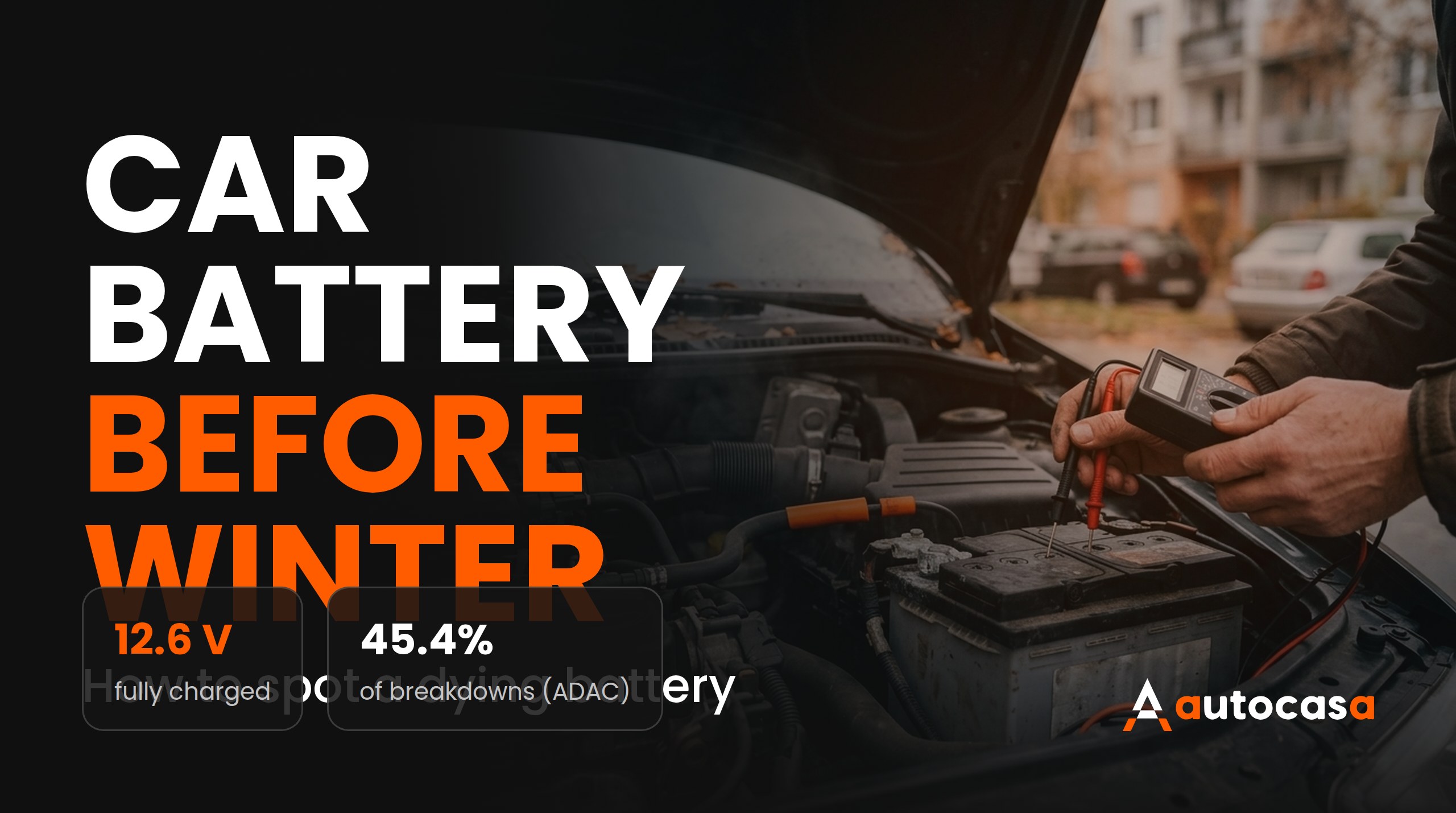
You turn the key and the starter only manages a tired half-turn. Breakdown statistics put the starter battery at the top of the list of reasons a car ends up stranded – and the first cold nights are the exam a weak battery fails. The good news: you can check its condition yourself in a few minutes, and autumn is the time to do it.
Why autumn decides, not the first frost
In 2025 the German motoring club ADAC attended more than 3.69 million roadside breakdowns, and 45.4 % of all call-outs were caused by a faulty or flat starter battery. It has been the number one cause for years – and it applies to combustion cars and electric cars alike, since EVs carry their own 12-volt battery.
The reason is chemical. A lead-acid battery works best at around 20 °C. As the temperature drops, the reaction inside slows down – according to manufacturer Varta, at freezing point it runs at roughly a quarter of what it manages at room temperature. At the same time a cold engine with thick oil needs more energy to turn over. The battery delivers less exactly when more is asked of it.
That is why a battery rarely dies on the first frosty morning without warning. It had been on its way out all summer; with a warm engine you simply did not notice. Autumn is the last calm moment to find out in your own driveway rather than in the car park before work.
Five signs the battery is on its way out
- The starter cranks more slowly than it did a month ago, especially after a cold night or a few days parked.
- The lights dim noticeably while cranking and only brighten once the engine fires.
- The electronics behave oddly – the radio resets, warning lights flicker, driver assistance faults pop up after starting.
- Start-stop has stopped working. This is one of the earliest symptoms: the control unit is protecting the battery because it no longer sees any reserve.
- The battery is four years old or more. Typical life is about four to six years, less with a lot of short trips. The production date is on the label or stamped into the case.
Measure it yourself: what the voltmeter should show
A multimeter costing a few euros tells you more than any guess. Measure after the car has stood for at least a few hours and has not been on a charger – this is the resting voltage. For a 12-volt lead-acid battery the rough guide is:
- 12.6 – 12.7 V – fully charged and healthy.
- 12.2 – 12.3 V – roughly half charged. In winter that already means a real risk of not starting.
- 11.7 – 12.0 V – deeply discharged. Do not crank it in this state; recharge it with a charger first.
- 13.8 – 14.4 V with the engine running – that is how the alternator should be charging. A consistently lower reading means the problem is the charging system, not the battery.
If the battery loses voltage quickly after charging, look for a parasitic drain. With the car locked and the control units asleep, the draw should be in the tens of milliamps, as a rule up to around 50 mA. Anything higher means something in the car never went to sleep – and the battery pays for it.
Short trips do more damage than frost
Starting alone uses a serious chunk of energy that the alternator then has to put back. On a five-minute run to the shop it simply cannot, even with a brand-new battery. Add heated windows, heated seats and headlights, and the battery leaves every trip slightly emptier than it started. A few weeks of that and one morning the car will not start at all.
Long periods of standing are no better. If the car sits for weeks, an occasional longer continuous drive helps, or simply a charger with a maintenance mode. Small things matter too: clean, tight terminals with no white deposit, and a battery firmly clamped in its bracket so vibration does not break the internal connections.
Start-stop: EFB, AGM and battery registration
If the car has a start-stop system, replacing the battery is not a case of “unbolt it and buy the cheapest”. These cars use EFB or AGM batteries, which tolerate far more cycles. The rule is simple: an EFB may be replaced with an EFB or an AGM, but an AGM only with an AGM. An ordinary flooded battery does not belong in a start-stop car – the vehicle’s charging strategy is set up for a different type and the battery will not last.
The second point is registering the new battery with the control unit. The system remembers how a worn battery accepts charge and charges it accordingly. If you do not tell it that a new one is fitted, it may charge incorrectly and start-stop will stay switched off. On brands such as Volkswagen, Škoda, Audi, BMW and Mini the registration is done with a diagnostic tool; other makes learn the new battery gradually by themselves. At the workshop, simply ask.
What to check when viewing a used car
The battery is no reason to walk away from a car, but it is a good indicator of how the previous owner treated it. When you go to see the car, look at:
- Arrive to a cold car and have it started in front of you. A pre-warmed engine hides a lot.
- Check the production date of the battery and whether its type suits the car (a start-stop car should have an EFB or AGM).
- White or greenish deposit on the terminals, grease and traces of electrolyte point to neglected servicing.
- Bulging battery sides are a reason for replacement, not for haggling over a few euros.
- Test whether start-stop shuts the engine down once the car is warm. If it does not, ask why.
When it is time to replace it
Choose the new battery by case size, terminal position and above all by the capacity and cold cranking current specified by the car manufacturer. Going smaller never pays off. The old battery does not belong in household waste – it contains lead and acid, so hand it in at a collection point or at the shop where you buy the new one.
And if the swap leaves you with a working battery, a charger you no longer use or other parts from a previous car, AutoCasa has a spare parts category where you can offer them to other drivers. The marketplace operates in Slovakia and Czechia, listings are free, with no sales commission and no limit on the number of ads; promoting a listing is optional and starts at 1.50 €. Alongside parts you will find cars, motorcycles, vans and trucks, buses, trailers, wheels and tyres, and bicycles.
Breakdown figures come from the ADAC statistics for 2025 (published in 2026), technical values from battery manufacturers and workshop practice, as of September 2026. Always check the exact battery type and specification in your own vehicle’s owner manual.
Leave a Reply